
Wise in Colombia: How I Transfer Money From the U.S. and Manage My Money
Wise in Colombia:
Living in another country eventually creates a very practical question:
How do you get your money from the United States to where you actually need it?
For me, the answer has become pretty simple.
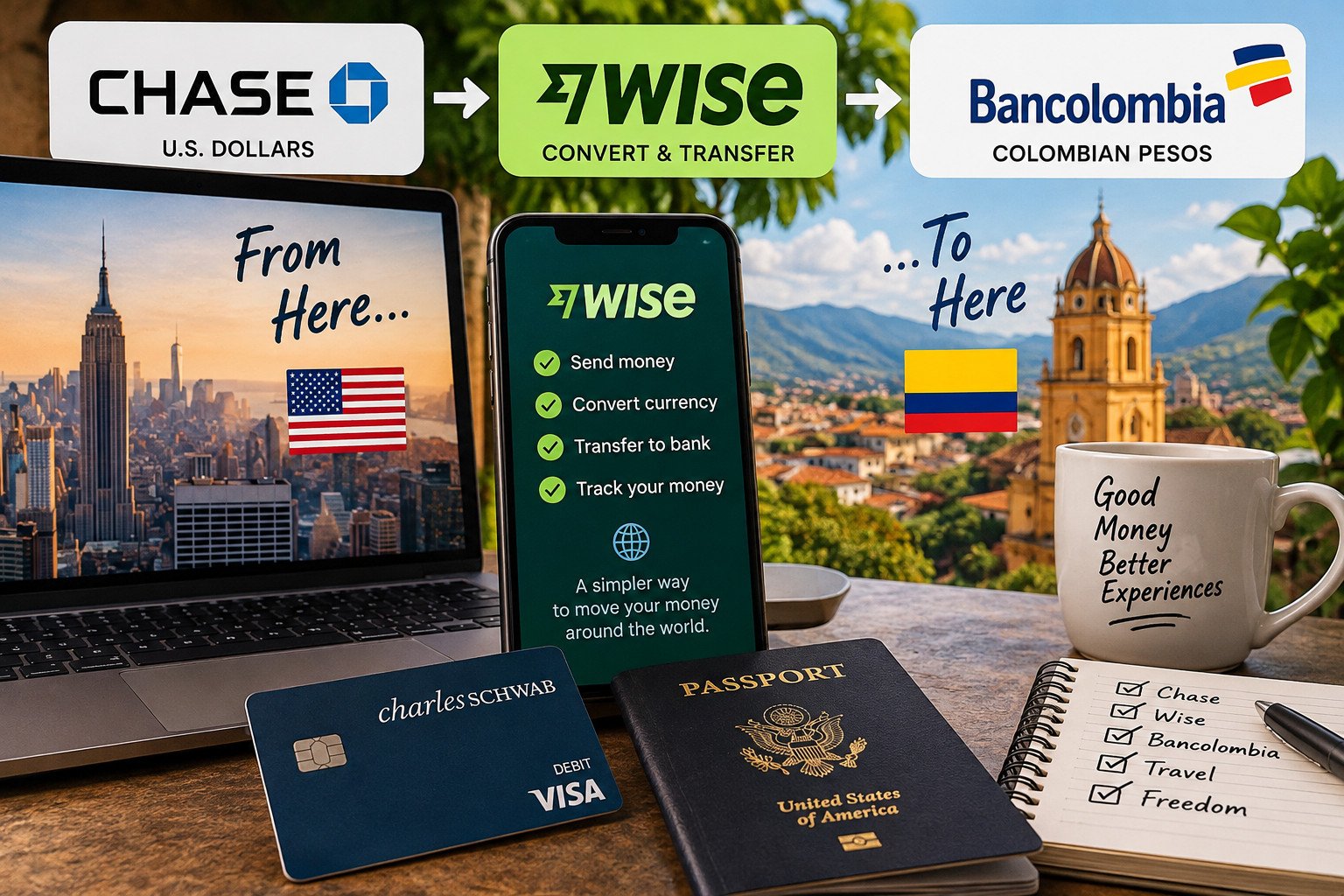
I keep most of my U.S. banking relationship with Chase, use Wise in Colombia to move and convert money, and then transfer Colombian pesos into my Bancolombia account.
I also maintain a Charles Schwab account and debit card, which has become particularly useful when I’m traveling and need access to cash through an ATM.
None of this was something I had completely figured out when I first started spending significant amounts of time outside the United States. I’ve tried different ways of moving and accessing money over the years.
Today, however, my system is pretty straightforward:
Chase → Wise → Bancolombia
And for me, it works.
Why I Use Wise in Colombia
Wise is an international money-transfer service that allows you to move money between currencies and bank accounts.
In my case, I’m moving U.S. dollars from the United States and ultimately putting Colombian pesos into my own Colombian bank account.
The attraction for me isn’t complicated.
I want to know approximately what exchange rate I’m receiving, what the transfer is costing me and how much money is going to arrive in Colombia.
Wise shows the exchange rate and fees before you complete a transfer, rather than leaving you to figure out afterward what happened to your money.
Wise currently supports transfers of Colombian pesos into personal accounts at several Colombian banks, including Bancolombia, Banco de Bogotá, BBVA, Davivienda and others, as well as Nequi wallets.
For me, though, the important part isn’t the list of banks.
It’s how it works in real life.
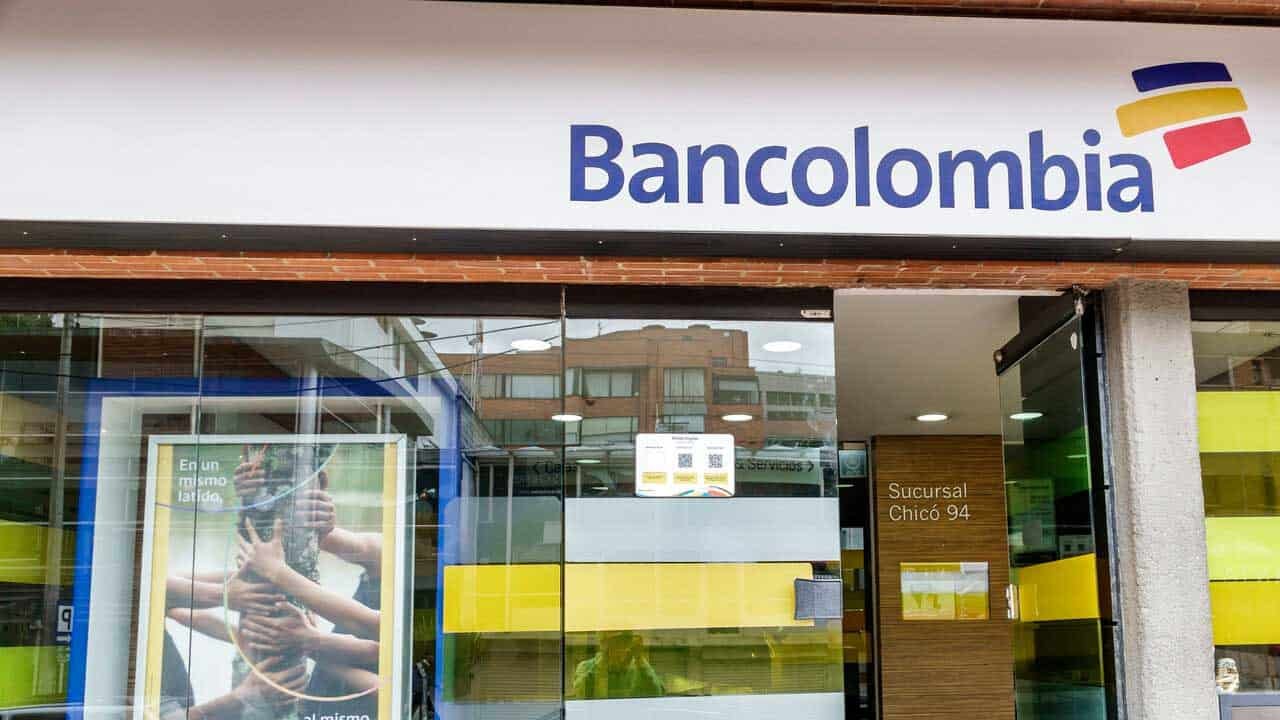
My Chase to Wise to Bancolombia Process
My money starts in my Chase account in the United States.
From there, I transfer the amount I want into Wise. In my experience, that portion is usually almost automatic. Most of the time I don’t feel as though I’m sitting around waiting for the money to become available.
Once the money is there, I make the conversion and send the Colombian pesos to my Bancolombia account.
That’s it.
Under normal circumstances, I’ve had the money appear in Bancolombia almost instantaneously or within about 30 minutes.
That’s my experience, however—not a promise that your transfer will arrive in 30 minutes.
I’ve had exceptions.
Around holidays, I’ve had transfers that weren’t instantaneous and took an extra day or two. So if I absolutely need money in my Colombian account on a certain day, I don’t think it’s wise to wait until the last minute and assume every transfer will behave exactly like the previous one.
Banking systems have schedules, holidays happen and transfers can be delayed.
But most of the time, my experience has been remarkably quick.
One Thing Bancolombia Customers Need to Know
There’s an important technical detail if you’re planning to send money through Wise to a Bancolombia account.
Wise says Bancolombia recipients need to have Abono Automático enabled to receive these transfers automatically. Bancolombia itself describes Abono Automático as the service that allows incoming international remittances to be deposited directly into a savings account.
That’s worth setting up before you’re sitting in another country wondering why your money hasn’t arrived.
Once everything is established, however, my own Chase-Wise-Bancolombia routine has become pretty uneventful.
And when you’re dealing with your money, uneventful is good.
The Exchange Rate Still Matters
Wise doesn’t eliminate the reality of currency exchange.
If you earn your income in dollars and live in Colombia spending pesos, the USD/COP exchange rate directly affects your purchasing power.
I’ve experienced both sides of that.
When the dollar is strong against the Colombian peso, my U.S. income buys more here. When the peso strengthens against the dollar, the exact same Colombian expense costs me more in U.S. dollars.
That’s one reason I pay attention to the rate when I’m moving money.
But I’ve also learned not to build my entire life around trying to predict currencies.
I need pesos to pay Colombian expenses.
Sometimes that means converting money at a rate I like. Sometimes it means converting money because the electric bill, rent, groceries and everything else don’t care whether I like today’s exchange rate.
That’s simply part of living internationally.
[INTERNAL LINK: Cost of Living in Colombia vs USA (2026): What I Actually Spend]
Wise Isn’t My Only Financial Tool
There’s another part of my system that has become very important, especially when I travel:
my Charles Schwab debit card.
I use Chase for most of my U.S. banking, but Chase and Charles Schwab are separate financial institutions. My Schwab account gives me another way to access my U.S. money while I’m outside the country.
And I’ve had a couple of experiences that made me appreciate having that option.
How I Avoid ATM Fees in Colombia
Moving money into Colombia is only part of my banking setup. I also need an affordable way to access cash when I’m here or traveling elsewhere. In this video, I explain how I avoid ATM fees in Colombia and the banking setup I use to manage and access my money while living abroad.
I Lost My Wallet in Argentina
Travel long enough and eventually something is going to happen.
On one trip to Argentina, I lost my wallet.
Losing your wallet at home is irritating. Losing it while you’re in another country creates a different problem because suddenly you’re thinking about access to money, cards and how you’re going to replace everything while you’re thousands of miles from home.
I dealt with the Schwab card and had it replaced.
That experience alone reinforced something I already believed about international travel: don’t depend on one card or one way of accessing your money.
But my more recent experience in Curaçao was even more interesting.

Then an ATM in Curaçao Kept My Schwab Card
During my September 2026 trip to Curaçao, an ATM kept my Charles Schwab card.
The machine simply didn’t give it back.
Now I’m dealing with another lost card—but this time I knew exactly where it was. It was sitting somewhere inside an ATM in Curaçao, which wasn’t particularly useful to me.
I resolved the issue with Schwab over the phone and they replaced the card.
But what impressed me was what happened next.
I live in Colombia. I didn’t want the replacement card sent to a U.S. mailing address where it would sit until the next time I returned to the United States.
Schwab was able to send the replacement directly to me in Colombia.
It came by DHL.
I had it in about two days.
That’s the kind of customer-service detail that matters much more to me now than it would have when I lived full-time in the United States.
When you live abroad, getting a replacement debit card isn’t simply a matter of walking out to your mailbox at your American address.
My experience showed me that I could actually solve the problem while remaining in Colombia.
Why I Like the Schwab Debit Card for International Travel
There’s another reason the Schwab debit card has become useful to me.
Schwab’s Investor Checking debit card currently provides unlimited rebates of eligible ATM withdrawal fees worldwide, and Schwab doesn’t assess a foreign transaction fee on foreign-currency debit-card transactions. ATM rebates are credited at the end of the month.
That can make a difference if you travel frequently.
There’s an important catch, though.
Foreign ATMs sometimes ask whether you want the ATM to convert the withdrawal into U.S. dollars. That’s known as Dynamic Currency Conversion, or DCC.
Schwab specifically warns that if you accept that conversion, the additional DCC charge isn’t considered an ATM withdrawal fee and isn’t covered by Schwab’s ATM-fee rebate.
So don’t confuse ATM fee reimbursement with every possible fee or bad exchange rate an ATM can offer you.
The card is useful.
It doesn’t make every ATM decision a good one.
Charles Schwab Investor Checking information
Why I Don’t Depend on Just One Bank
My Argentina and Curaçao experiences illustrate something that I think is especially important for retirees and long-term travelers.
I don’t want all of my financial access dependent on one institution or one piece of plastic in my wallet.
Today I have relationships with U.S. and Colombian financial institutions, along with Wise serving as the bridge I commonly use to move money between the two countries.
That gives me options.
If a card disappears into an ATM, I have another way to get money.
If I’m waiting for a replacement card, my financial life doesn’t stop.
If I need pesos in my Colombian account, I can transfer them rather than relying entirely on ATM withdrawals.
That’s not a sophisticated international banking strategy.
It’s redundancy.
And living abroad has taught me that redundancy matters.
What I Would Tell Someone Moving to Colombia
If you’re moving to Colombia from the United States, I wouldn’t wait until after the move to figure all of this out.
Establish your U.S. banking relationships while you’re still in the United States. Decide how you’re going to access cash internationally. Set up your money-transfer service. And if you’re opening a Colombian bank account, understand what that bank requires to receive international transfers.
Wise says that for transfers into Colombia, the recipient’s identifying information needs to match the information registered with the Colombian bank. For Bancolombia specifically, the Abono Automático requirement is another thing to get straight beforehand.
I would also carry more than one card when traveling—and don’t keep every card in the same wallet.
That last lesson becomes pretty obvious after you lose a wallet in Argentina.
Is Wise in Colombia Worth Using?
For me, yes.
I don’t claim that Wise is the only way to transfer money to Colombia or that it will necessarily be the cheapest solution for every person and every transaction.
It’s simply the system that has worked well for me.
My routine is straightforward:
Money in Chase → transfer to Wise → convert dollars to Colombian pesos → transfer to Bancolombia.
Most of the time, the process has been extremely fast. Occasionally, particularly around holidays, I’ve experienced delays of a day or two.
Combined with my Schwab account and debit card for accessing money while traveling, I’ve developed a system that gives me several ways to reach my money rather than depending on just one.
Living abroad has taught me that moving money internationally doesn’t need to be complicated.
But you should understand how your system works before you desperately need it to work.
For me, Wise, Bancolombia, Chase and Charles Schwab each serve a different purpose.
And after losing a wallet in Argentina and having an ATM eat my card in Curaçao, I appreciate having those options more than I used to.